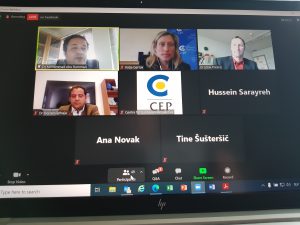
The Euro-Atlantic Council of Slovenia, the Centre of European Perspective – CEP and the Politics and Society Institute hosted a webinar on the threat of radicalisation and violent extremism across borders. The debate was moderated by Katja Geršak, executive director of the Centre of European Perspective.
Speakers of the seminar:
- Dr Mohammad Abu Rumman, Politics and Society Institute, Associate Expert and Writer on Political Islam and Violent Extremism
- Dr Florian Qehaja, Kosovar Centre for Security Studies, Chair of the Board
- Dr Iztok Prezelj, Euro-Atlantic Council of Slovenia, President & Faculty of Social Sciences, University of Ljubljana, Vice-Dean
Dr Rumman: The rise of ISIS led to thousands of Jordanians leaving Jordan to fight. In the Jordanian society, very serious changes happened. They started adopting the ISIS ideology. Previously, mostly men adopted their ideology, but now the families are the ones who adopt the ideology of ISIS. In Jordan, the extremists can be divided into two groups. The first group is supporting Al Qaeda and its ideology, while the second supports the ISIS ideology, which is more extreme. The supporters have an increasingly high level of education (students, PhD…) and live comfortably. Dr Rumman pointed out that Jordan became the number one in exporting extremism.
Dr Qehaja: An estimated 403 Kosovars in total joined the war zones in Syria and Iraq between 2012 and 2018. In the beginning, people had no clue about radicalisation and extremism, but are now more aware of it. The potential of a terrorist attack is much lower. Kosovo was one of a relatively small number of countries which were prepared to repatriate its citizens from Syria. Kosovo has established a dedicated unit in the Ministry of Internal Affairs to provide continuous reintegration support. Repatriated citizens are supported by emergency packages, housing, and access to the social welfare scheme. Kosovo also passed a law which prohibits joining armed conflicts outside the state territory of the Republic of Kosovo. The challenge was an exaggerated support of donners in some de-radicalisation programs; the support was not coordinated, which was actually counterproductive.
Dr Prezelj: When the Covid-19 crisis started, it was expected that terrorism globally and in Europe would increase, but that did not happen. What happened is an increase in polarisation and radicalisation of our societies. Slovenia never faced a terrorist attack on its soil and does not face a threat to the government in terms of a standing terrorist group. Dr Prezelj pointed out that Slovenia works as a tampon area between jihadists from Austria, Bosnia and Italy. Slovenia is actually a transit country for jihadist people, weapons and explosives. Around 10 people from Slovenia were foreign fighters who all went to fight in Syria through Turkey to fight for ISIS or Al Nusra. Some NGOs invited certain foreign preachers who came to talk about problems and injustices in the world. They also wanted to recruit the Roma people due to their Slovenian passports. Foreign intelligence reported on one social gathering that took place in Slovenia as a cover for military training of jihadists from Austria, Germany, Slovenia and Bosnia. Police forces foiled a suicide terrorist attack by a Croatian citizen, who wanted to carry out attacks in Ljubljana. All this means that Slovenia can not be “a non-case” of radicalisation, it is actually a real case. Slovenia also has a right-wing paramilitary extremist group, which tried to take over border control instead of the police and armed forces.
Speakers also answered some questions from the public related to women and extremism, social and mass media, deradicalization and reintegration.